Kinnevik
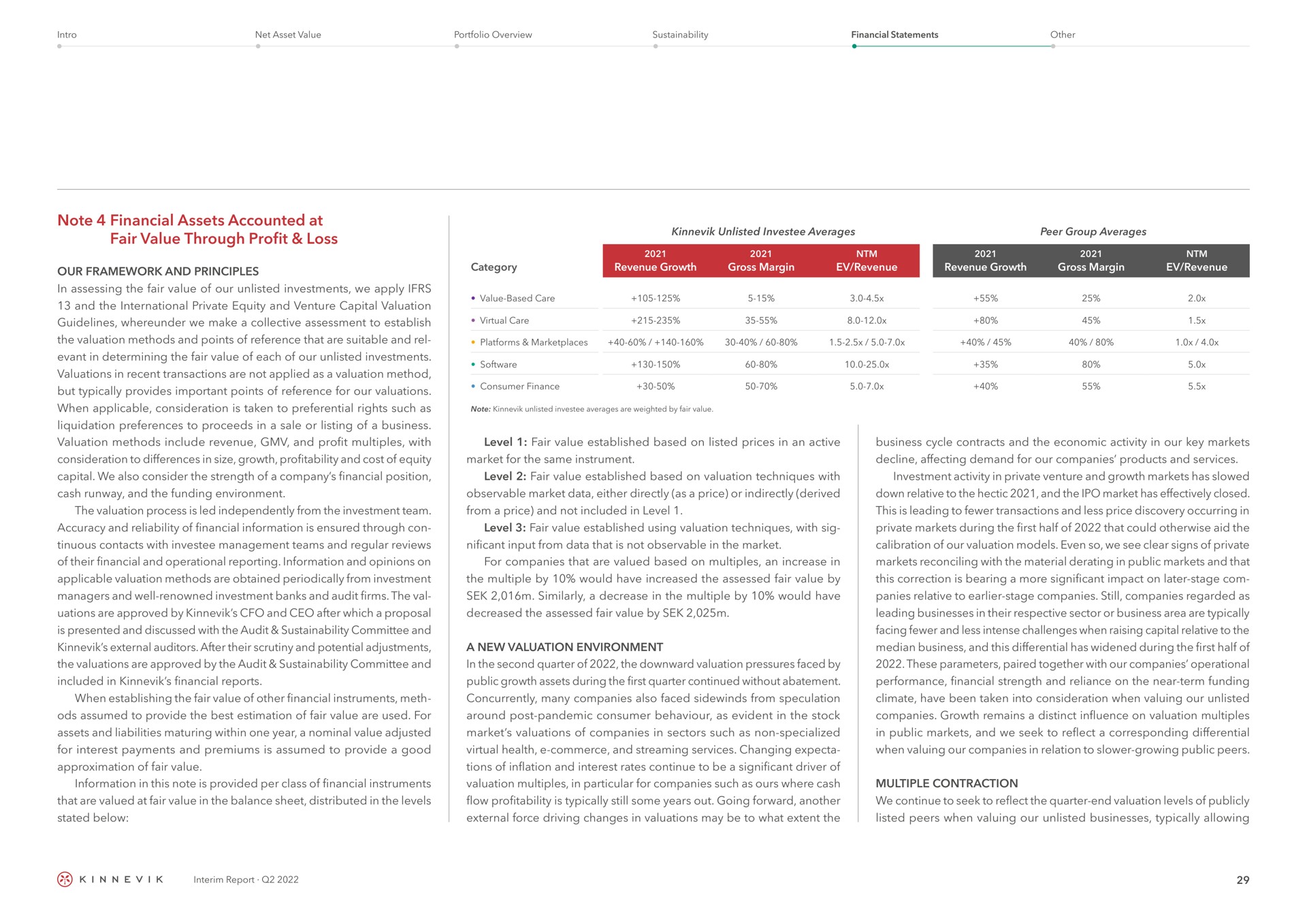
note financial assets accounted at fair value through profit loss our framework and principles in assessing the fair value of our unlisted investments we apply and the international private equity and venture capital valuation guidelines whereunder we make a collective assessment to establish the valuation methods and points of reference that are suitable and rel in determining the fair value of each of our unlisted investments valuations in recent transactions are not applied as a valuation method but typically provides important points of reference for our valuations when applicable consideration is taken to preferential rights such as liquidation preferences to proceeds in a sale or listing of a business valuation methods include revenue and profit multiples with consideration to differences in size growth profitability and cost of equity capital we also consider the strength of a company financial position cash runway and the funding environment the valuation process is led independently from the investment team contacts with management teams and regular reviews of their financial and operational reporting information and opinions on applicable valuation methods are obtained periodically from investment managers and well renowned investment banks and audit firms the are approved by and after which a proposal is presented and discussed with the audit committee and external auditors after their scrutiny and potential adjustments the valuations are approved by the audit committee and included in financial reports when establishing the fair value of other financial instruments ods assumed to provide the best estimation of fair value are used for assets and liabilities maturing within one year a nominal value adjusted for interest payments and premiums is assumed to provide a good approximation of fair value information in this note is provided per class of financial instruments that are valued at fair value in the balance sheet distributed in the levels stated below level fair value established based on listed prices in an active market for the same instrument level fair value established based on valuation techniques with observable market data either directly as a price or indirectly derived from a price and not included in level level fair value established using valuation techniques with sig input from data that is not observable in the market for companies that are valued based on multiples an increase in the multiple by would have increased the assessed fair value by similarly a decrease in the multiple by would have decreased the assessed fair value by a new valuation environment in the second quarter of the downward valuation pressures faced by public growth assets during the first quarter continued without abatement concurrently many companies also faced from speculation around post pandemic consumer behaviour as evident in the stock market valuations of companies in sectors such as non specialized virtual health commerce and streaming services changing of inflation and interest rates continue to be a significant driver of valuation multiples in particular for companies such as ours where cash flow profitability is typically still some years out going forward another external force driving changes in valuations may be to what extent the business cycle contracts and the economic activity in our key markets decline affecting demand for our companies products and services investment activity in private venture and growth markets has slowed down relative to the hectic and the market has effectively closed this is leading to transactions and less price discovery occurring in calibration of our valuation models even so we see clear signs of private markets reconciling with the material derating in public markets and that this correction is bearing a more significant impact on later stage relative to stage companies still companies regarded as leading businesses in their respective sector or business area are typically facing and less intense challenges when raising capital relative to the median business and this differential has widened during the first half of these parameters paired together with our companies operational performance financial strength and reliance on the near term funding climate have been taken into consideration when valuing our unlisted companies growth remains a distinct influence on valuation multiples in public markets and we seek to reflect a corresponding differential when valuing our companies in relation to growing public peers multiple contraction we continue to seek to reflect the quarter end valuation levels of publicly listed peers when valuing our unlisted businesses typically allowing could otherwise aid | Kinnevik
Company
Deck Type
Deck date
July 2022
Slide
29 of 46
Similar slides by Kinnevik
Results
February 2023
Results
October 2022
Results
April 2022
Related slides by other companies
Activist
April 2017
Results
November 2024
Results
November 2023
Investor Presentation
February 2020
Other recent decks by Kinnevik
Investor Day
October 2024
Results
July 2024
Results
July 2023
Results
July 2023
Search Thousands of Presentations by World Leading Companies

Stay in the loop

Join our mailing list to stay in the loop with updates and newest feature releases

© 2021-2024 Slidebook.io